

Few moments call for more care and less certainty than choosing flowers after a loss. You want to honor someone well, support a grieving family, and get it right — but the etiquette around sympathy flowers isn’t something most of us learn until we need it.
We’ve had the honor of walking alongside many South Carolina families through this exact season, and we wanted to gather what we’ve learned into one gentle, practical guide.
First: There Is No Perfect Gesture
Before anything else, it’s worth saying plainly — there is no wrong bouquet sent with a genuinely caring heart. Etiquette guidelines exist to help you feel confident, not to add pressure to an already heavy moment. If you’re reading this while grieving yourself, or while trying to support someone who is, please be gentle with yourself. A thoughtful gesture, however imperfect, is always received as love.
Where to Send Flowers
To the funeral home or church, for the visitation or service, is the most traditional choice — these are typically larger arrangements meant to be seen from a distance: standing sprays, wreaths, or casket arrangements.
To the family’s home, either before or after the service, is a warmer and increasingly common choice — especially in the weeks following, when the initial wave of support has quieted and the house can feel very still. A smaller arrangement or potted plant sent two or three weeks after the funeral is often deeply meaningful, precisely because it arrives after everyone else has stopped checking in.
To the graveside, for a smaller, more private service, is appropriate when specified by the family.
If you’re not sure which is right, it’s always acceptable to ask the funeral home directly, or to send flowers to the family’s home as the safest, most universally appropriate choice.
What to Send
Standing sprays and wreaths are traditional for the service itself and are typically sent by immediate family, close extended family, or on behalf of an organization (a workplace, church group, or club).
Casket sprays are almost always reserved for immediate family — it’s generally considered appropriate to check with the family before sending one yourself.
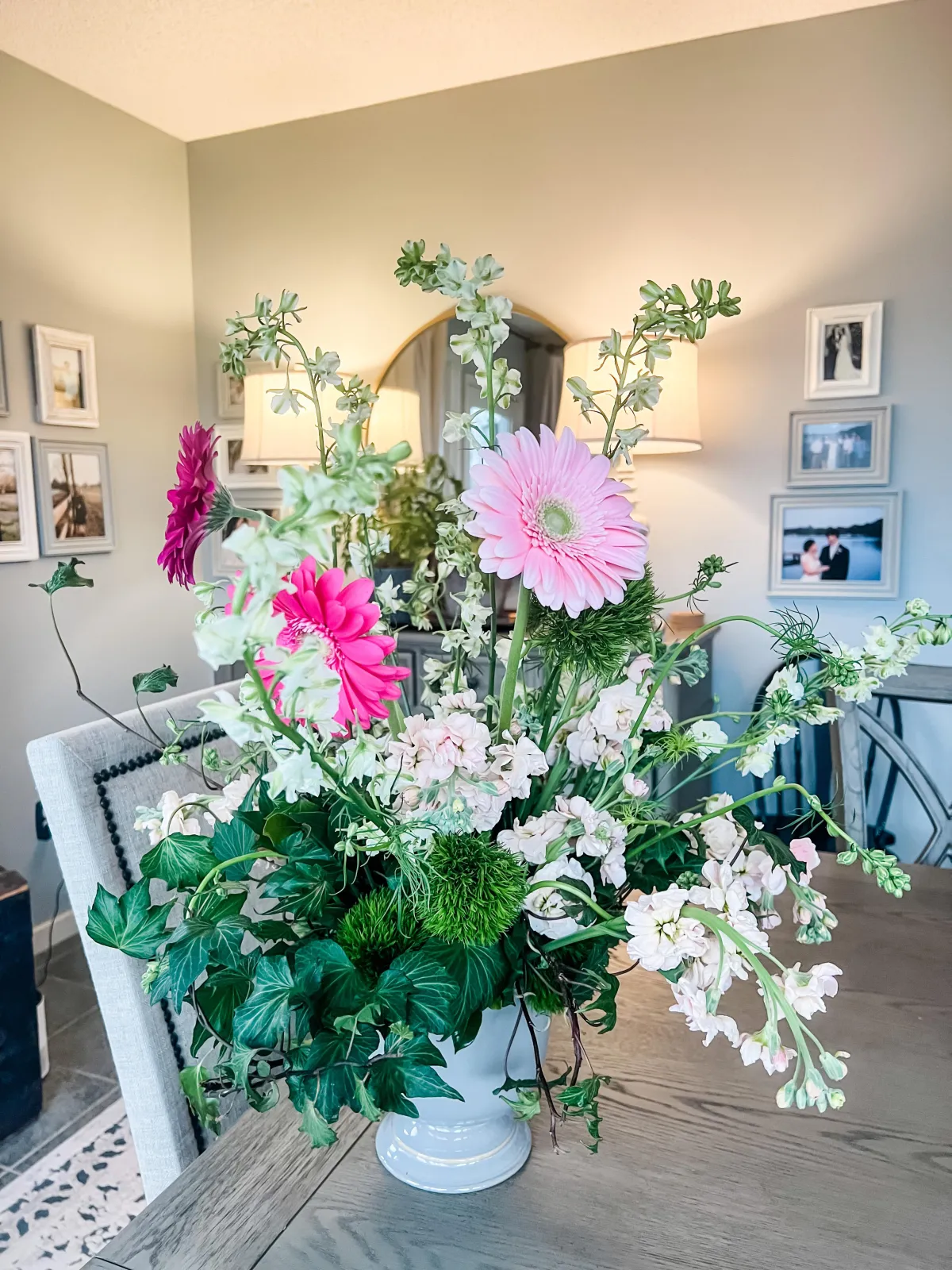
Vase arrangements and bouquets, like our flower garden and extra large arrangements, are a warm, flexible choice for the family’s home, appropriate from friends, coworkers, and more distant relatives alike.
Potted plants — an orchid, a peace lily, a small blooming plant — are a lovely choice specifically because they outlast the week of the funeral. They can be replanted, kept on a windowsill, or moved outdoors, offering a quiet, ongoing reminder of care long after the flowers themselves would have faded.
Fruit or gourmet baskets are a thoughtful alternative when flowers may not be the right fit — more on that below.
What to Consider Before Sending
Check for a request in the obituary. Many families now write “in lieu of flowers, donations may be made to…” This isn’t a rejection of flowers as a gesture — it’s simply the family’s stated preference, and honoring it matters more than the specific form your care takes. If a cause is named, a donation is the most respectful choice. If you’d still like to send something in addition, a smaller gesture sent to the home afterward is a lovely way to do both.
Consider religious and cultural customs. Some traditions have specific guidance around flowers at funerals — for example, in traditional Jewish and Muslim practice, flowers are less customary and donations or meals are often preferred instead. When in doubt, a quiet call to the funeral home or a mutual friend familiar with the family’s traditions can help you avoid an unintentional misstep.
Think about timing. Flowers for the service itself typically need to arrive the morning of or the day before, coordinated directly with the funeral home. Flowers sent afterward, to the home, have much more flexibility — and as mentioned, often mean the most when they arrive after the initial flurry of support has passed.
Choose a card message that doesn’t require a reply. Simple, warm messages — “Thinking of you,” “With deepest sympathy,” “Holding your family close” — are far kinder in this moment than anything that asks a grieving person to find the words to respond.
Colors and Meaning, If You’d Like a Starting Point
There’s no rule requiring specific colors, but if it helps to have a starting point: white traditionally represents peace and remembrance, while soft pastels and garden greens can feel gentle and hopeful rather than somber. Deeper jewel tones and rich autumnal colors are a beautiful, personal choice for someone who loved bold color in life. The most meaningful arrangements are often the ones that reflect something true about the person being remembered — their favorite flower, a color from their garden, a bloom tied to a memory.
We’re Here to Help You Get It Right
If you’re not sure what to send, when to send it, or how to word the card, please don’t hesitate to call us. We’ve guided many South Carolina families through exactly this moment, and we would be honored to help you find the right way to say what’s in your heart — whether that’s a single quiet bouquet or a service full of flowers.
Browse our funeral and visitation flower options — including standing sprays and casket arrangements, garden boxes, and compote arrangements — to see the range of what we can deliver, often same-day.
For same-day and next-day sympathy arrangements in Anderson and the Upstate, reach out to our team — we’re glad to help, even on short notice.