
Your bridal bouquet will be in your hands for more of your wedding day than almost anything else you wear. It’s in the ceremony photos, the portraits, the first look, the reception entrance. So choosing the right one matters — not just aesthetically, but practically.
We’re Poppies and Peonies, a boutique wedding florist based in Anderson, SC. We’ve designed bridal bouquets for weddings across the Upstate — intimate backyard ceremonies, barn celebrations in the Blue Ridge foothills, formal ballroom receptions in Greenville. Here’s everything we walk our couples through when choosing a bouquet.
The Main Bridal Bouquet Shapes
Start with shape before you get into flowers. The silhouette of your bouquet frames your dress, your hands, and your overall look in every photo.
Round (or Posy)
The most classic shape — a dense, dome-shaped arrangement of blooms held tightly together. Round bouquets are timeless, photograph cleanly from any angle, and suit a wide range of wedding styles from traditional to modern. If you’re unsure where to start, start here.
Garden-Gathered
Soft, slightly asymmetrical, with flowers and greenery that look like they were just pulled from a garden. This style has been enormously popular in Upstate SC weddings over the past several years — it works beautifully outdoors and photographs with an effortless quality. More of a curated wildness than a structured shape.
Cascading
A bouquet that flows downward — sometimes dramatically, sometimes with just a gentle drape of greenery and trailing blooms. Full cascading bouquets are striking in portraits, but heavier to carry and require more attention to hold at the right angle. If you love the look, we’ll make sure you’re comfortable with it before the day.
Arm Sheaf (or Presentation Bouquet)
Long-stemmed flowers gathered and cradled in the crook of the arm rather than held in front. Elegant, modern, slightly unconventional. Works especially well with simple, structured gowns and flowers with long natural stems — tulips, calla lilies, anemones.
Compact or Petite Posy
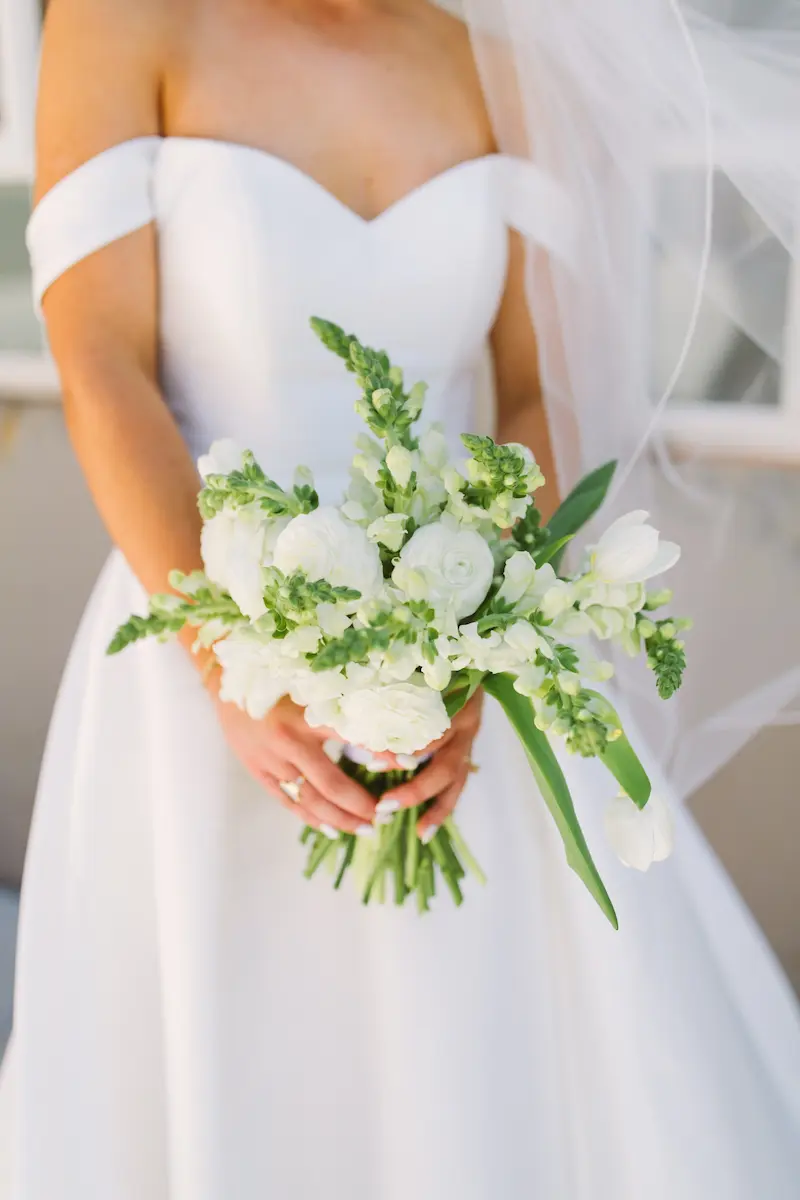
A smaller, tighter version of the round bouquet. A great choice for brides who want something dainty, who have a dress with significant detail that shouldn’t compete with a large bouquet, or who simply don’t love carrying something large all day.
How to Match Your Bouquet to Your Dress
Heavily Embellished Gowns (Lace, Beading, Embroidery)
A simpler, cleaner bouquet lets the dress breathe. Monochromatic whites and creams, soft greenery, or a focused single-bloom design won’t compete with intricate lace or beadwork. One thing should be the star at a time.
Simple or Minimalist Gowns (Crepe, Satin, Clean Lines)
This is where a more elaborate bouquet can shine. A lush, layered garden bouquet or a full cascading design adds visual interest that a simple gown doesn’t provide on its own. You have room to go bold with color, texture, or volume.
A-Line and Ball Gowns
Round and cascading bouquets both work beautifully here. The proportions of a fuller skirt can carry a larger bouquet without looking overwhelming.
Sheath and Column Gowns
An arm sheaf or a long, loosely gathered bouquet echoes the clean vertical line of the dress. Round bouquets can feel slightly at odds with the silhouette — not wrong, just worth being intentional about.
Choosing Flowers for Your Bouquet: What Works in SC
Flower choice affects both the look and the logistics of your bouquet. In South Carolina’s climate, some flowers hold up better than others — especially for outdoor summer ceremonies.
The Classic Choices (Always Beautiful, Always Available)
- Garden roses — lush, layered, and available year-round via import. One of our most-requested blooms.
- Ranunculus — delicate, papery petals with incredible depth. Peak season is late winter through spring.
- Lisianthus — often mistaken for peonies or roses; frilly and full without the price tag. Hardy in heat.
- Spray roses — smaller, clustered, and incredibly versatile. Work well as a filler or a focal flower.
The Statement Flowers (Worth Planning Around)
- Peonies — everyone’s favorite, but strictly late spring (April–June). If you want peonies outside that window, they’ll need to be specially sourced and will cost more. Worth it? Often yes.
- Dahlias — dramatic, full, and available in dozens of forms. Peak season in SC is late summer through fall.
- Anemones — graphic, high-contrast, striking in black-and-white photography. A winter and early spring bloom.
- Sweet peas — soft, trailing, impossibly romantic. A true spring bloom that doesn’t last long in summer heat.
What Holds Up in SC’s Summer Heat
If you’re getting married outdoors in June, July, or August in South Carolina, heat and humidity are real variables. Flowers that hold up best: lisianthus, spray roses, garden roses (especially antique varieties), zinnias, dahlias, and dried or preserved elements. Flowers to be careful with in peak summer heat: sweet peas, ranunculus, and delicate tropicals that wilt quickly.
We always condition our flowers carefully and pack bouquets in cool water until the last possible moment before hand-off. We’ll also advise you honestly if a flower you love might struggle on your specific wedding day.
Color: How to Think About It
Monochromatic (All One Color Family)
White-on-white, blush-on-cream, all-deep-red — monochromatic bouquets are elegant, photograph with incredible richness, and look intentional even at distance. The trick is layering different textures and bloom sizes so it doesn’t look flat.
Complementary Colors
Pulling two colors from opposite ends of the spectrum (peach and dusty blue, terracotta and sage, burgundy and blush). When done well, complementary palettes feel lively without feeling chaotic.
Neutral with a Pop
A primarily white and green bouquet with one accent color — a deep plum, a coral, a dusty mauve — is a classic for a reason. It’s versatile, photographs well in any light, and lets the focal flower carry the design.
What If Your Colors Are Hard to Source?
True blue is almost impossible naturally in flowers, and exact pantone matches rarely exist in nature. We’ll always be upfront about what’s achievable and help you find a floral interpretation of your palette that feels true to your vision.
Practical Questions We Always Ask
- Indoor or outdoor ceremony? Heat and direct sunlight affect flower choices.
- Time of year? This shapes what’s available at peak quality and best price.
- How long is your day? A four-hour timeline versus a twelve-hour day affects how we condition and pack your flowers.
- Do you have a photographer? Knowing their style (bright and airy vs. rich and moody) helps us choose flowers that photograph beautifully in their aesthetic.
- What’s your overall vibe? Rustic, romantic, modern, minimalist, maximalist — these words actually mean something to us when we’re designing.
What Does a Bridal Bouquet Cost?
At Poppies and Peonies, bridal bouquets typically range from $175 to $350. A compact garden-style bouquet with seasonal blooms sits toward the lower end. A lush, cascading design using peonies, garden roses, and ranunculus at peak bloom sits toward the top.
Bridesmaids bouquets run $75–$150 each — coordinating in style but scaled down. For a more detailed breakdown of all wedding floral costs, see our SC wedding flower cost guide.
Let’s Design Yours
Choosing a bridal bouquet should feel exciting, not overwhelming. Our job is to ask the right questions, show you what’s possible within your budget and season, and then build something that feels genuinely like you — not like a template from a wedding blog.
We work with couples throughout Anderson, Greenville, Clemson, Seneca, and the broader Upstate SC area. Get in touch here to start the conversation — we’d love to hear about your wedding.
If you’re considering full-day coordination alongside your florals, our wedding planning services are designed to make sure your flowers, your timeline, and every other detail work together seamlessly.
Take a look at our portfolio to see bouquets we’ve designed across different styles, seasons, and budgets.
From full-service planning to partial coordination and support for intimate celebrations and elopements — if you’re getting married in Upstate South Carolina, we’d love to be your florist and planning team.